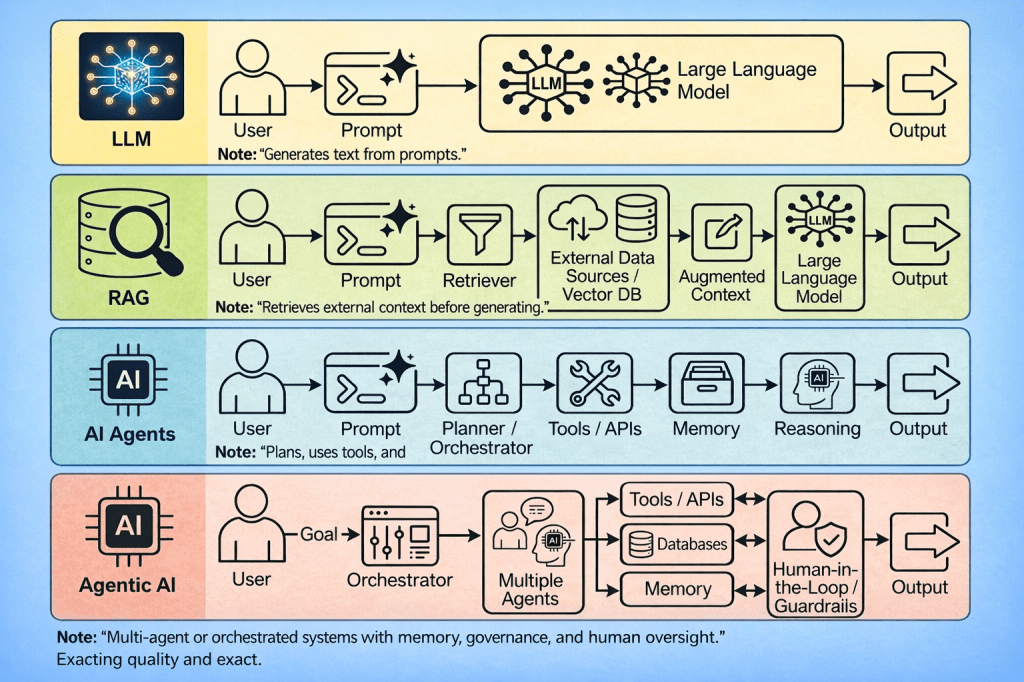
Level 1: Core reasoning engine
An LLM at this stage works mainly as a text-reasoning and generation model. It can explain ideas, summarize content, and answer questions, but it does not natively use tools, keep long-term memory, or pull in live information. As a result, it may miss recent events or facts that are outside its training data.
Level 2: Connected problem-solver
At this stage, the model is linked to external systems such as search, retrieval, or databases. That connection lets it look up current information, compare sources, and assemble a grounded answer. This is where the system begins to act less like a static model and more like a practical assistant.
Level 3: Strategic problem-solver
Here, the system can break tasks into steps, choose tools intentionally, and manage context more carefully. Context engineering becomes important because the model must carry forward only the most relevant information at each step. This fits current 2026 practice, where stronger orchestration and better context handling are often more important than raw model size.
Level 4: Collaborative multi-agent systems
At this level, specialized agents work together under a coordinator. One agent may research, another may draft, and another may verify or enforce policy. This matches the 2026 shift toward orchestration, role separation, memory, and governance rather than one monolithic agent doing everything.
2026 perspective
The biggest trend in 2026 is not just autonomy, but bounded autonomy: agents that are useful, observable, and governed. Production systems increasingly combine retrieval, tools, memory, validation, and human review. So these levels are best used as a practical framework for explaining capability growth, not as a universal taxonomy.
Common Framework Supports Each Level
| Level | What it does | Common frameworks / platforms | Notes |
|---|---|---|---|
| Level 1: Core reasoning engine | Standalone text generation and reasoning | Model APIs such as OpenAI, Anthropic, Gemini, and Hugging Face-based model stacks | These are model interfaces, not full agent frameworks. |
| Level 2: Connected problem-solver | Uses search, retrieval, databases, and external tools | LangChain, LlamaIndex, OpenAI Agents SDK, Bedrock Agents | Best for RAG, tool calling, and grounded answers. |
| Level 3: Strategic problem-solver | Manages state, branching, retries, and multi-step workflows | LangGraph, LlamaIndex, OpenAI Agents SDK, Bedrock Agents, Rasa CALM | Best when orchestration and context control matter. |
| Level 4: Collaborative multi-agent systems | Coordinates multiple specialized agents | CrewAI, AutoGen, LangGraph, Google ADK, Bedrock multi-agent patterns | Best for delegation, collaboration, and workflow decomposition. |
Hope! this post may be helpful to you guys. Thanks for your time. Please subscribe for more updates!


Leave a Reply